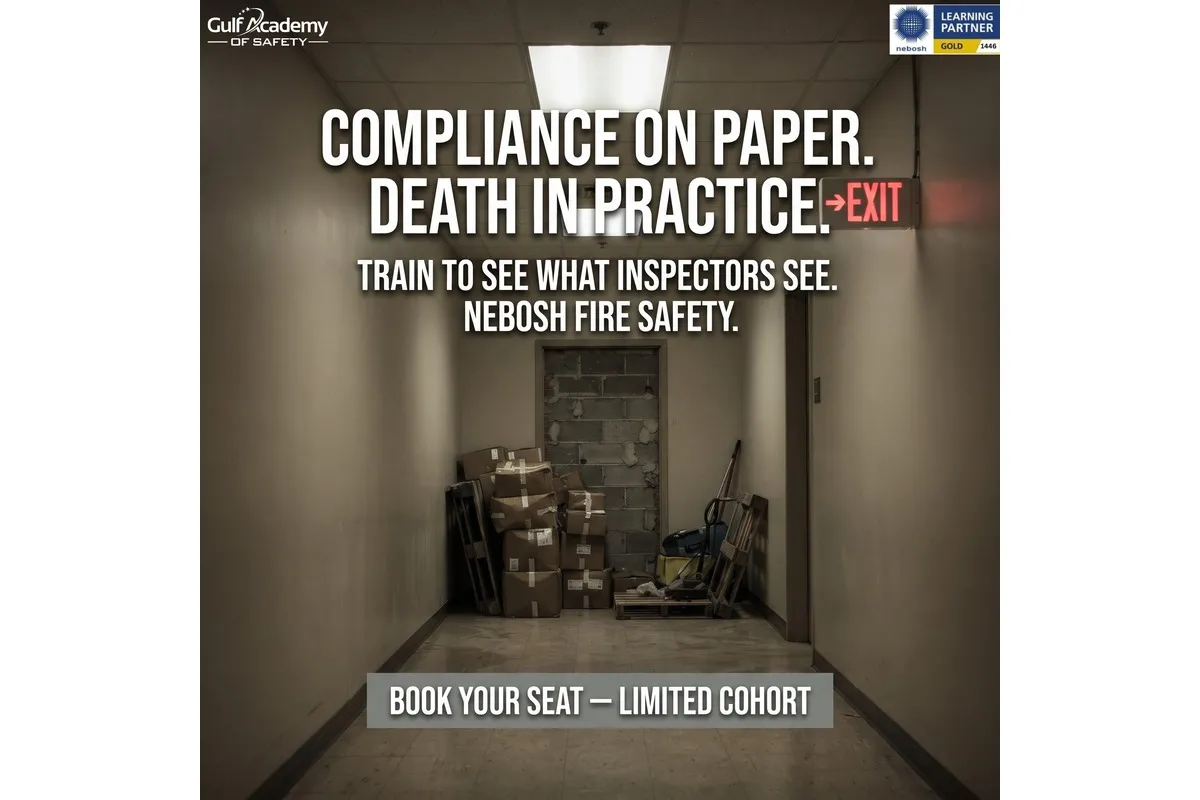
NEBOSH Fire Safety Course: Time, Study Modes & Entry Rules
Before signing up for any qualification, three questions usually come first: how long will it take, how will I study, and am I eligible? Here are straight answers for the NEBOSH Fire Safety Course.
What the qualification is
The NEBOSH Certificate in Fire Safety is a Level 3 qualification, comparable in level to an A-Level. It is a Vocational Related Qualification (VRQ), which means it is geared to practical, job-ready skills rather than purely academic learning.
You learn to manage fire safety responsibilities, understand how fires start and spread, control fuel, oxygen, and ignition sources, assess building fire protection, plan for the safety of people, and carry out fire risk assessments.
Entry requirements: who can enrol?
There are no formal entry requirements. You do not need a prior health and safety qualification or a technical background.
The one practical requirement is English. The course involves reading scenarios and writing clear answers, so NEBOSH recommends a level around IELTS 6.0. If your English is strong enough to handle workplace reports, you are probably in good shape.
This makes the course accessible to fire marshals, wardens, facilities managers, health and safety representatives, supervisors, and career changers.
How long will it take?
Plan for about 60 hours in total. That is made up of at least 28 taught hours and roughly 20 hours of private study, with the remainder covering assessment and preparation.
How that time is spread depends on how you study:
- Classroom or virtual: about five days of intensive instruction and assessment
- Online or distance learning: self-paced, with flexible access for up to a year
If you work full-time, a longer, self-paced schedule may suit you better. If you prefer to get it done quickly, the five-day format gives you momentum.
Choosing your study mode
Gulf Academy Safety lists three delivery options: classroom, e-learning, and online. The qualification is the same in each, so choose on how you learn best.
Classroom learning gives you face-to-face contact with tutors and classmates. It suits people who like discussion, structure, and instant feedback, and it can be useful for networking.
Live online learning keeps the tutor interaction but removes the travel. It works well if you want structure but cannot be in a specific location.
E-learning gives maximum flexibility. You choose when to study, which helps with shift work, travel, or family commitments. It needs self-discipline, because nobody will nudge you except you.
How you are assessed
Two units must be passed:
- FSC1: a 24-hour, scenario-based open book exam completed remotely
- FSC2: a practical fire risk assessment carried out in a real workplace
Exam dates for FSC1 are fixed each quarter, and registration is handled by your learning partner, so check dates early. After registration, NEBOSH sends a confirmation email with your learner number.
Certificates are typically issued within 40 working days of completing both units.
Picking a good provider
The syllabus is standard, so the quality of the learning experience varies by provider. Ask about:
- Tutors: Do they have real fire safety or workplace experience?
- Support for FSC2: Practical assessments are where people often need extra help.
- Schedule flexibility: Can you fit it around work?
- Practice and feedback: Will someone review your written answers?
- Official standing: Is the provider an approved NEBOSH learning partner? Gulf Academy Safety describes itself as a NEBOSH Gold Learning Partner.
A realistic study plan
If you are studying part-time, try this structure:
- Set fixed study slots. Two or three sessions a week beat one long weekend.
- Study the elements in order. They build on each other.
- Apply each topic to your workplace. Look at real fire doors, real extinguishers, real exits.
- Practise scenario answers early. Do not wait until the final week.
- Plan your practical in advance. Arrange access and permissions before you need them.
Is the qualification recognised?
Yes. NEBOSH is widely recognised by employers in the UK, the Middle East, and beyond. Because the qualification is regulated and assessed externally, a certificate holder in one country means the same as in another. That portability matters if your career may take you across borders.
Where can it lead?
The certificate works on its own for roles such as fire safety officer, advisor, or risk assessor. It can also be a stepping stone to the NEBOSH General Certificate, the International Diploma, or specialist pathways like Process Safety Management.
Final thought
If you were worried that a recognised fire qualification would be out of reach, the facts suggest otherwise. There are no formal entry hurdles, the time commitment is manageable, and flexible study options make it realistic alongside a job. What you need is clear intent and a plan.
If you want fire and safety NEBOSH training that fits your life, start by looking at the options in detail.
👉 Check study options for the NEBOSH Fire Safety Course at Gulf Academy Safety and pick the format that suits you.

About Premium Author
This post has been authored and published by one of our premium contributors, who are experts in their fields. They bring high-quality, well-researched content that adds significant value to our platform.